
Revolutionizing water,
to feed humanity, and turn deserts green
Building on decades of proven greenhouse science to test whether saltwater cooling can cut water use across open desert farmland.
The research program — testing saltwater cooling in open US fields, then at regional scale.
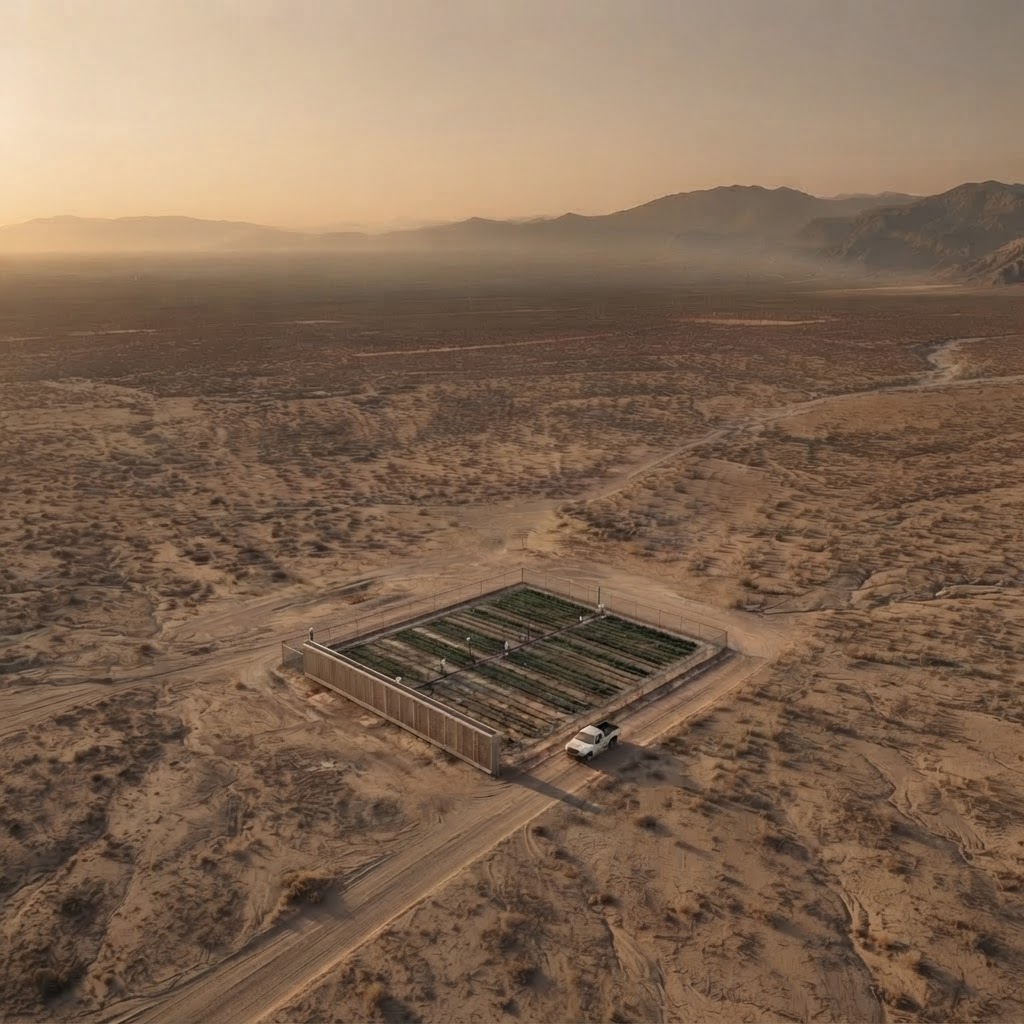
Initial Proof of Concept Deployment
Field site to be confirmed
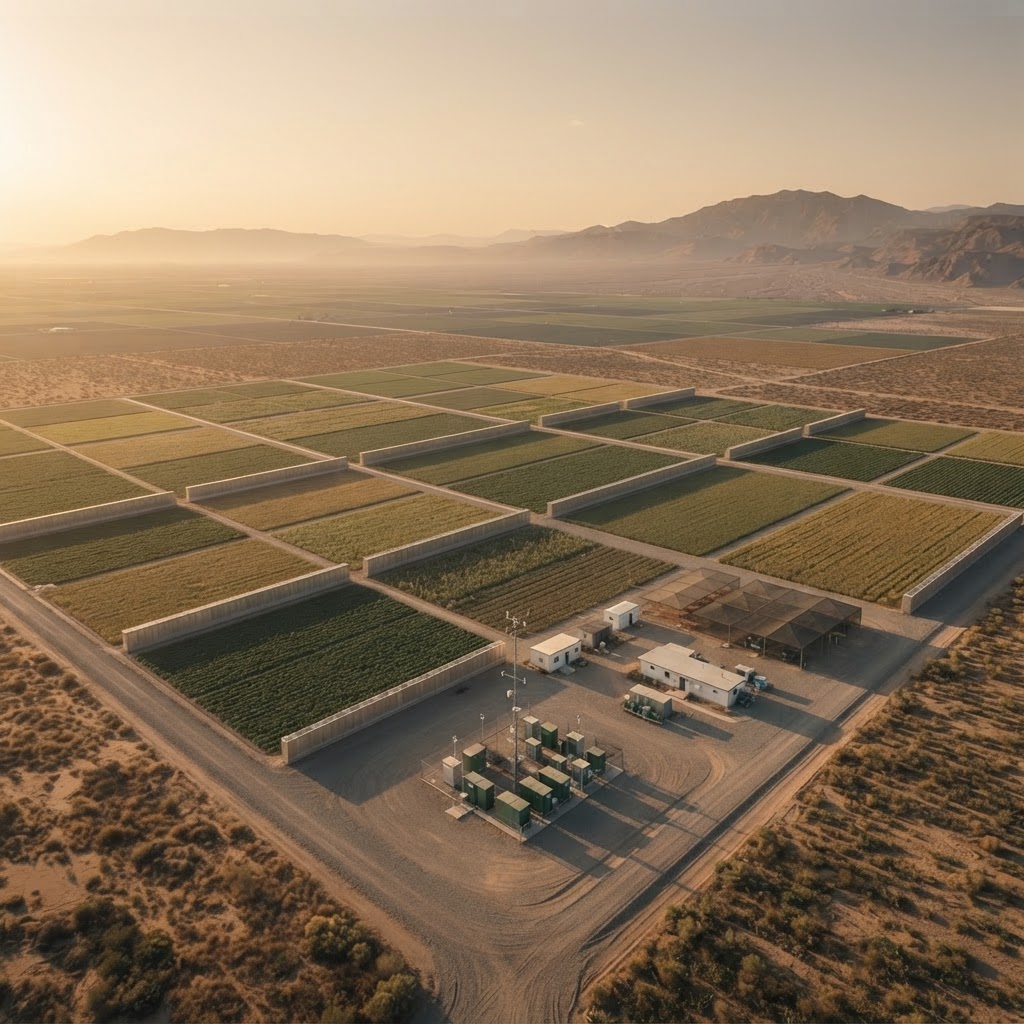
Imperial Valley Pilot Deployment
Holtville, California (proposed)

Salton Sea Ecosystem Restoration & Regional Transformation
Salton Sea, California
Initial Proof of Concept Deployment
Field site to be confirmed
Imperial Valley Pilot Deployment
Holtville, California (proposed)
Salton Sea Ecosystem Restoration & Regional Transformation
Salton Sea, California
The Next Giant Leap for Mankind
Revolutionizing desert agriculture to unlock water abundance, make the desert bloom and feed the next 6 billion people.
Fertilizer fed 6 billion people
"It is estimated that a third of annual global food production uses ammonia from the Haber–Bosch process, and that this food supports nearly half the world's population"
– Oxford Scientist

Abundant water could feed
the next 6 billion

The Science Is Established. The Next Frontier Must Be Proven.
Decades of evaporative-cooling research demonstrate that saline water can be used to create cooler, more humid growing environments. E2Eden's next challenge is determining whether these benefits can extend beyond enclosed greenhouses into commercially viable open-field agriculture. Our research will measure cooling persistence, crop response, net freshwater savings, environmental impacts, and economic performance under real desert conditions.
Established
Evaporative cooling works
Evaporative cooling is well-understood physics, and Seawater Greenhouse deployments have demonstrated saltwater cooling inside enclosed, high-humidity structures across a range of arid climates. Those results come from covered greenhouses, not open fields.
Our hypothesis
It may extend to open fields
Saline-water cooling walls may lower net freshwater requirements in open-field and semi-open desert agriculture by reducing evaporative demand downwind of the wall. This has not yet been demonstrated at field scale.
Proposed research
Measured, not asserted
Instrumented field trials will quantify cooling reach, net freshwater savings, crop stress and yield, salt and soil impacts, and economics under real desert conditions, with results published as measured.
Where a claim cannot be substantiated, it is stated as a hypothesis or left out. Results will be published as measured, including where the hypothesis does not hold.
Research library →Saltwater Cooling Walls
A powerfully simple idea: a cardboard wall continuously drenched in saltwater, cooling the air that moves across a field. What previous greenhouse work established is the cooling physics. What our field research will establish is how much of that cooling reaches a crop — and how much freshwater it actually saves.
Reported reduction in irrigation water use in enclosed greenhouse deployments.
Reported cooling of the air passing through the saltwater-drenched wall.
Reported rise in relative humidity inside the cooled greenhouse environment.
These figures are reported results from Seawater Greenhouse research in enclosed greenhouse systems. They are not yet verified for open-field agriculture, and their transferability to the specific climatic regions we intend to deploy in — extreme heat, very low humidity, high evaporative demand — remains to be demonstrated. Proving that transferability, region by region, is the purpose of our field trials.


Slows the Wind
Hot desert wind strips the layer of moisture above the fields. Slowing the wind protects this layer.

Cools the Wind
As salty water evaporates through the panels, it absorbs heat from the air. That cooled, humidified air is denser than the hot desert air around it and settles toward the field.

Humidifies the Wind
The drenched walls raise the humidity of the air passing through them, which can lower the drying pull — the vapor-pressure deficit — on the crop downwind. How far that effect carries is what our trials measure.
Agriculture Uses About 80% Of California's Water
Irrigated desert farms are where water is used, lost, and must be saved. Shares vary by state and year; in California, agriculture accounts for roughly four-fifths of developed water supply.

We farm in deserts
Farms were pushed into deserts, where high evaporative demand means crops need far more water than in temperate climates.

Water evaporates away
In low-desert heat, a multi-cut forage crop can move more than six feet of water per acre to the atmosphere in a year.

Desalination costs more than crops can pay
Desalinated supply runs about $3,400 per acre-foot. An acre of alfalfa grosses roughly $4,000 and uses several acre-feet. The math rarely works.
Water Price per Acre-Foot
Cities pay up to 90x more for the same water IID farmers receive — a gap rooted in century-old water rights. Municipal and agricultural rates are not strictly comparable, but the difference shapes what any new supply can be sold for.
Watch
The Water Wars Have Begun
With water we conquered the desert. But there are no more untapped rivers. The struggle has just begun.

We Tamed Mighty Rivers
We dammed the Colorado, Nile, and Yangtze—bending nature's power to feed our cities.

We Watered The Desert
Aqueducts and canals stretched hundreds of miles. We moved water to where nature never intended—turning wasteland into farmland.

We Fed Millions From Sand
Imperial Valley, the Negev, the Arabian Peninsula—deserts bloomed, harvests grew, and millions were fed from once-barren land.

And Built Cities From Nothing
Las Vegas, Phoenix, Dubai, Cairo—great civilizations rose in Earth's harshest places, all standing on borrowed water.

But Our Rivers Are Dry
Lake Mead has fallen roughly 180 feet since 2000. The Colorado no longer reaches the sea. We spent centuries of water in decades.

The Water Wars Have Begun
States sue states. Nations threaten nations. The fights over what's left are already here—and only getting fiercer.

Now Cities Buyout The Farmers
Unable to find more water, cities and investors buy farmland and fallow it permanently. Farmers walk away with a check and no future.

Leaving The Towns To Die
When farms go, everything goes—feed stores, equipment dealers, restaurants, jobs. Rural communities collapse into poverty.

As The Land Turns To Dust
The Salton Sea and Owens Lake show the cost: exposed lakebeds become toxic wastelands, leaving public health crises and environmental collapse.
Three Proposed Research Sites
We are proposing three field sites in California, Israel and Jordan, where the same question is asked under the same conditions: extreme heat, scarce freshwater, and agriculture that cannot afford to stop. We begin in Imperial Valley—one of the hottest, driest places in North America, yet one of the most productive agricultural regions in the world. If the cooling economics can be made to work here, they can be tested anywhere.


UC Desert Research & Extension Center
Holtville, Imperial Valley, CA · Prospective collaboration
Lead investigator: Jason McBride · U.S. Investigator, E2Eden
The site we are proposing for our proof-of-concept field trial: an instrumented comparison of cooled and untreated plots in one of the hottest, driest agricultural regions on Earth. This is a planned trial, not an operating E2Eden farm.

Arava Institute for Environmental Studies
Kibbutz Ketura, Arava Valley, Israel · Sabha desalination brine
Lead investigator: Dr. Clive Lipchin · Prime Investigator, AIES
The Israeli pilot site will use brine discharge from the Sabha desalination plant, which supplies potable water to Eilat, on plots irrigated from brackish groundwater. Temperature, humidity, vapour-pressure deficit, wind and crop water use are measured against untreated plots. A proposed site: field work begins only if the proposal is funded.

Khayrat Wadi Araba First Agriculture Investment Company
Aqaba Governorate, Wadi Araba, Jordan · Brackish groundwater
Lead investigator: Waddah Maayta · MENA Investigator, CEO of KWA
KWA will host the Jordanian pilot site on a working farm that irrigates from brackish groundwater. The same instrumentation, control hardware and test protocol as Israel and California are applied to locally relevant crops, water sources and soils. A proposed site, not an operating E2Eden facility.

Vegetable growing near Aqaba, Jordan · Aktron / Wikimedia Commons, CC BY-SA 4.0
One lead investigator per site: E2Eden's field engineering in California, paired with independent research institutions in Israel and Jordan, each running the same test protocol on its own water, soils and crops.
Israel
Dr. Clive Lipchin
Arava Institute for Environmental Studies (AIES)
Prime Investigator. Leads the Israeli field site and, with KWA, the shared Israel–Jordan research framework.
Jordan
Waddah Maayta
Khayrat Wadi Araba First Agriculture Investment Company (KWA)
MENA Investigator. Leads the Jordanian field site and the joint water, materials and microclimate work.
United States
Jason McBride
E2Eden LLC
U.S. Investigator. Defines the shared instrumentation, controls and cloud-data system and runs the Imperial Valley test site.
Together, We Can Change THIS World
Feed 10 billion people. Save our water. Make deserts bloom.
The next green revolution starts now. Join us.