
Saltwater Cooling Walls
We substitute saltwater for fresh — cooling farms with brackish water unsuitable for drinking or irrigation, where a site has a usable supply. The cooling physics is established. The open-field application is what we are setting out to prove.
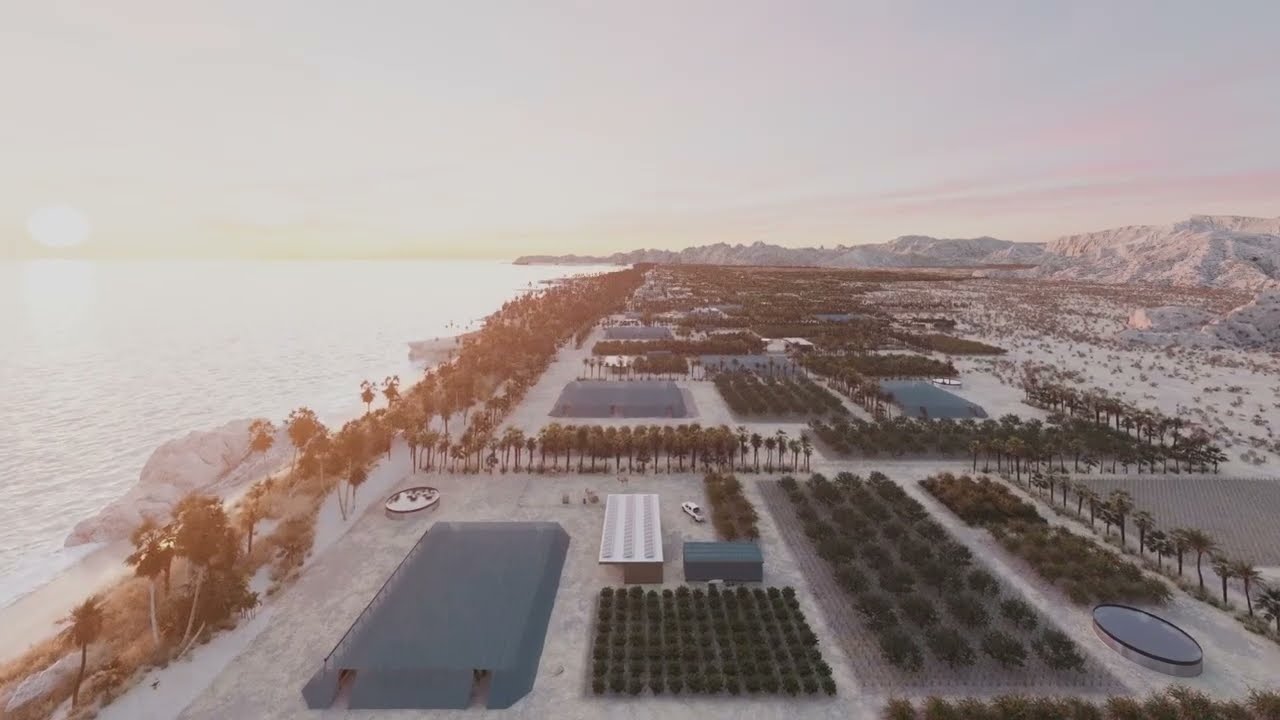
Watch
How Saltwater Cooling Walls Work
The Science Is Established. The Next Frontier Must Be Proven.
Decades of evaporative-cooling research demonstrate that saline water can be used to create cooler, more humid growing environments. E2Eden's next challenge is determining whether these benefits can extend beyond enclosed greenhouses into commercially viable open-field agriculture. Our research will measure cooling persistence, crop response, net freshwater savings, environmental impacts, and economic performance under real desert conditions.
Established
Evaporative cooling works
Evaporative cooling is well-understood physics, and Seawater Greenhouse deployments have demonstrated saltwater cooling inside enclosed, high-humidity structures across a range of arid climates. Those results come from covered greenhouses, not open fields.
Our hypothesis
It may extend to open fields
Saline-water cooling walls may lower net freshwater requirements in open-field and semi-open desert agriculture by reducing evaporative demand downwind of the wall. This has not yet been demonstrated at field scale.
Proposed research
Measured, not asserted
Instrumented field trials will quantify cooling reach, net freshwater savings, crop stress and yield, salt and soil impacts, and economics under real desert conditions, with results published as measured.
The questions we are testing
- 01
How much cooling can saline-water walls produce, and how far downwind does it persist?
- 02
Can microclimate modification reduce net freshwater irrigation requirements?
- 03
How does cooling influence crop stress, yield, and quality?
- 04
What are the risks of salt deposition, corrosion, scaling, and soil salinization?
- 05
Can sensor-driven optimization improve water and energy efficiency?
- 06
Under what conditions can the system be economically viable?
Where a claim cannot be substantiated, it is stated as a hypothesis or left out. Results will be published as measured, including where the hypothesis does not hold.
Research library →
Slows the Wind
Hot desert wind strips the layer of moisture above the fields. Our cooling walls act as a windbreak, protecting this critical moisture layer and reducing the drying effect on crops.

Cools the Wind
As saltwater evaporates through the panels, it absorbs heat from the air, so the air leaving the wall is cooler than ambient. How much of that drop persists downwind at crop height — and how it varies with wind, humidity and wall design — is the central measurement of our field trials.

Humidifies the Wind
The moisture does not vanish — it leaves the wall in the air. Higher humidity lowers the vapor-pressure deficit that drives transpiration, which is where any freshwater saving would come from. Whether that holds at field scale is the research question.
Most of the West's water is used in agriculture...
Irrigated farming is the largest consumptive water user in the Southwest, and where the savings have to come from. The ranges below are published low-desert applied-water estimates; actual use varies by season, soil and practice.

Alfalfa
4–6 acre-feet
per acre, per year
Multi-cut forage with a long growing season — the highest-volume irrigated crop in the lower Colorado basin.

Cotton
3–4 acre-feet
per acre, per year
Heat-tolerant, but still dependent on a reliable seasonal supply to establish and finish.

Vegetables & Melons
2–3 acre-feet
per acre, per year
Heat-sensitive and high-value — the crops most likely to benefit from buffering peak temperatures.
...Where desalinated water is hard to justify...
Delivered desalinated supply costs roughly five times more per acre-foot than an irrigated field crop can pay for its water.
per acre-foot · Carlsbad, 2024
gross value per acre-foot used
...And that gap is unlikely to close soon
Desalination continues to advance, but its cost and energy requirements can make it economically challenging for low-value, water-intensive agricultural applications. E2Eden is investigating an alternative approach: reducing freshwater demand rather than producing additional freshwater.
All figures in dollars per acre-foot. Indicative published benchmarks, not project measurements.
Desalinated supply costs well over 100x what a Colorado River farm pays for the same acre-foot of water — and roughly five times what a field crop can return on it.
...And there are few suitable tools for saving water in these environments
The tools available to large, mechanized field farming mostly deliver water more efficiently. They rarely change the crop's underlying demand for water.

Drip Irrigation
Complex to run under large-scale mechanized field operations, so it remains uncommon on commodity crops.
Rarely used on field crops

Greenhouses
Covered structures are capital-intensive and restrict field-scale mechanization.
Built for high-value crops

Pivot Irrigation
Delivers water efficiently, but does not reduce evaporative demand on the crop.
Addresses delivery, not demand
Except Saltwater Cooling Walls

What we use
Brackish groundwater — saline water that cannot be used for drinking or irrigation without treatment. Where a site has a usable supply, it is a far cheaper cooling input than freshwater. Availability varies by location, and assessing it is part of our field program.
What we replace
Freshwater irrigation — the resource that actually constrains agriculture. If cooling lowers evaporative demand, some of the water a crop currently loses to the atmosphere would not need to be replaced. How large that saving is in an open field is precisely what our trials are designed to measure.
The physics
Evaporative cooling is the same principle as sweating. As water evaporates, it absorbs heat from the air. Large wetted surface area lets that happen at scale with low-grade energy — the part of the system that is genuinely well established.
The scale
Each wall conditions the air that passes through it. How far that cooled air persists downwind determines how much land a wall can serve. Spacing, height and orientation are design variables our research will test at farm scale before any claim about regional systems can be made.